Astute Beta Server Guide is an independent mobile application security research group and player protection advocacy resource. We analyze mobile applications, document reverse engineering methodologies, capture telemetry on malicious distribution campaigns, and help mobile game players identify digital threats. This document outlines our hardware testing setups, threat grading matrices, binary signature verification pipelines, reverse-engineering workflows, and editorial guidelines.
1. The Rise of Modified APKs and the Threat to Mobile Gamers
Over the last decade, the landscape of mobile gaming has experienced an unprecedented evolution, transforming from simple, localized offline games to massive multiplayer online battle arenas (MOBAs) and battle royales that support millions of simultaneous users and process real-time transactions. This shift has made mobile players highly lucrative targets for cybercriminals, malicious actors, and unauthorized software distributors. The demand for competitive advantages, premium aesthetic customization items, early access builds, and unofficial system modifications has spawned a massive secondary market for third-party Android Packages (APKs).
This security threat is particularly evident during major game update cycles, such as Garena Free Fire’s Advance Server phases or standard OB updates (e.g., OB53). Players eagerly seek early access builds, leading to high search volumes for terms like the "Free Fire Advance Server APK" or unverified beta clients. Malicious actors exploit this demand by distributing repackaged files that mimic legitimate beta servers. These files are optimized for search engines, distributed on shady web forums, and marketed through social media channels to bypass Google Play Protect and other security controls. When players sideload these packages, they are not installing official, sandboxed software; instead, they are executing arbitrary code with system permissions on their personal devices.
Astute Beta Server Guide was established to address this exact challenge. We believe players have a right to understand the security implications of sideloading unofficial software. By conducting deep technical audits, reverse-engineering unverified game builds, and documenting threat telemetry, we provide the community with the tools and information necessary to protect their accounts, personal data, and hardware from modern mobile exploits.
2. Mission Statement and Detailed Editorial Standards
Our core mission is to provide objective, reproducible security analysis of mobile software packages to ensure player protection. We operate under a strict code of ethics and verify files using a multi-stage validation pipeline designed to eliminate subjective reporting and replace it with empirical security telemetry.
A. Binary Signature Verification Pipelines
Our signature verification pipeline is the first line of defense against repackaged software. When a file is analyzed, we extract and inspect its digital signatures to verify its origin:
- Signature Block Extraction: We run the target APK through Android’s official
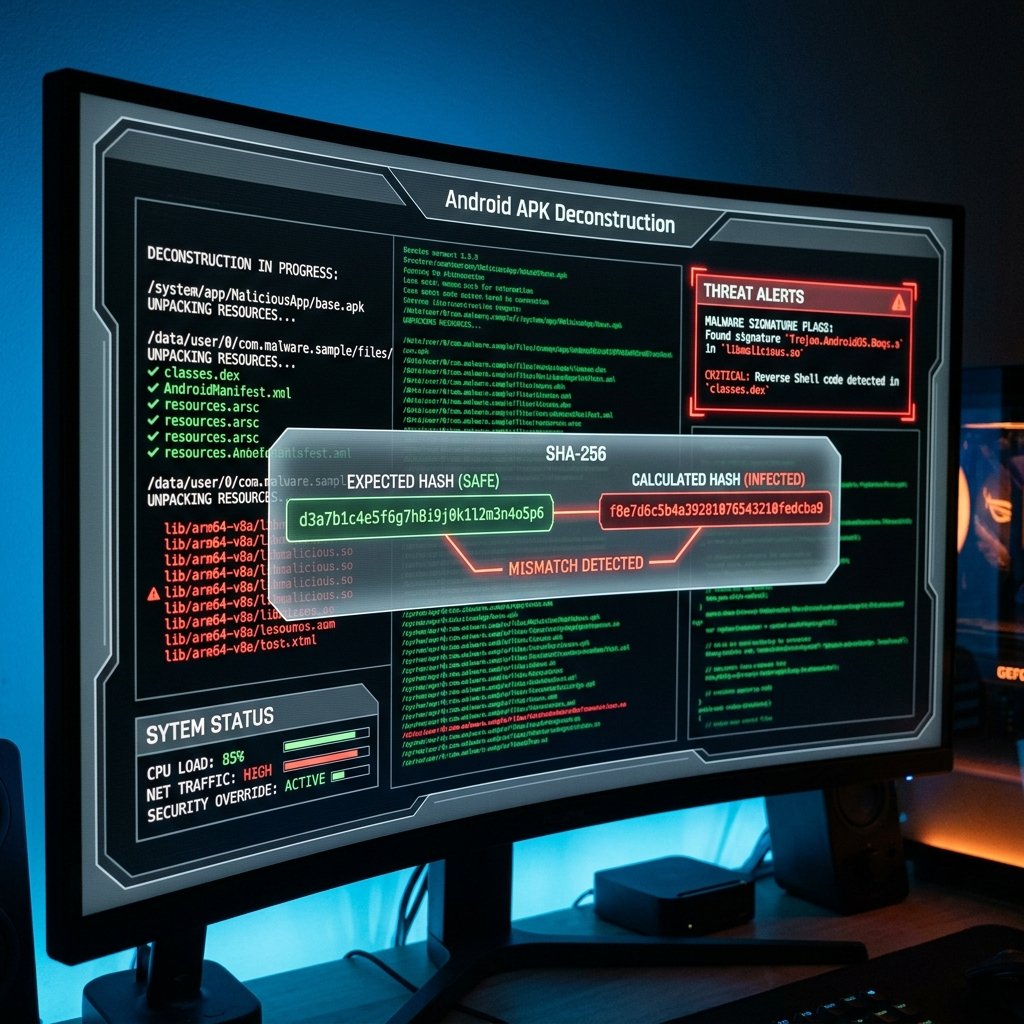
apksignertool and custom parsing scripts to extract the signing blocks. We inspect the metadata for JAR signing (v1 Scheme) and APK Signature Schemes v2, v3, and v4. - Cryptographic Fingerprint Computation: We compute the cryptographic hash of the developer’s public key certificate using the SHA-256 algorithm. This fingerprint serves as a unique identifier for the publisher.
- Registry Comparison: We compare the extracted SHA-256 fingerprint against our internal database of official publisher certificates (such as Garena’s official signing keys).
- Tampering Flagging: If the certificate signatures do not match the official developer certificate, the file is classified as custom-signed. In the mobile ecosystem, a custom signature indicates that the original application package has been unpacked, modified, and resigned with a third-party key. This is a critical indicator of unauthorized tampering, signaling that the application contains non-standard code that has not been vetted by the official developers.
B. Reverse-Engineering Methodology
When a signature mismatch is identified, we initiate a thorough reverse-engineering workflow to locate the changes:
- Control-Flow Graph Reconstruction: We decompile the Dalvik bytecode (DEX files) into intermediate Smali representation and Java code. We then map the control-flow graphs (CFGs) of critical classes, looking for anomalies such as dead-code insertion, obfuscated control flows, or unusual class coupling.
- Obfuscation Detection: Many malicious APKs use packers or protectors (such as Qihoo, SecShell, or custom DexGuard configurations) to hide their payload. We analyze the class loader structure to detect dynamic loading mechanisms that attempt to decrypt or unpack encrypted bytecode in memory during execution.
- Asset and Native Library Auditing: We inspect the
/assets/and/lib/directories. Unauthorized modifications often inject compiled native libraries (shared objects with.soextensions, likelibil2cpp.soor custom helper binaries) to hook into the game engine or modify native game variables in memory. We disassemble these libraries using Executable and Linkable Format (ELF) analyzers to audit their exported symbols and JNI system calls. - Permission Scope Auditing: We parse the
AndroidManifest.xmlto flag red flags such as requests for dangerous permissions. Any game application requesting access to SMS records, contact lists, system overlay hooks, accessibility services, or background package installations is automatically flagged for dynamic monitoring.
C. Sandbox Testing Configurations
Static analysis is not sufficient on its own, as modern malware often employs environment-aware checks to hide its behavior. To address this, we execute unverified binaries in isolated sandbox environments:
- Hypervisor Isolation: We run the application on Android Virtual Devices (AVDs) hosted on isolated bare-metal hypervisors. These VMs have no access to physical host networks, cellular data lines, or local network endpoints.
- SSL Unpinning and Proxy Chains: We route all outbound emulator traffic through intercepting proxies such as Fiddler and Burp Suite. To bypass SSL/TLS certificate pinning implemented by modern applications, we use dynamic instrumentation scripts (via Frida) to hook into SSL validation functions, allowing us to inspect all HTTPS requests in plaintext.
- Simulated User Input & Anti-VM Spoofing: Since malware often checks system properties (like build signatures, sensor arrays, or hardware temperature) to detect virtual environments, we configure our emulators with randomized hardware fingerprints. We run automated scripting tools to simulate realistic user behavior (keystrokes, swipe movements, screen rotations) to trigger deferred payloads.
D. Community-Driven Report Validation
Our database is constantly updated with reports from players and community members. To prevent false positives and malicious submissions, we apply a double-blind validation process:
- Initial Triaging: Incoming reports are automatically checked against a database of known file hashes (MD5, SHA-1, SHA-256) and verified against public virus registries (such as VirusTotal).
- Independent Lab Replication: If the file is not in our registry, two independent analysts download and run the binary through our static and dynamic pipelines without sharing their initial notes.
- Consensus & Publishing: A report is published only if both analysts independently confirm the presence of security risks, such as telemetry drainage, unauthorized third-party connections, or security bypass mechanisms.
3. Our Mobile Application Auditing Methodology & Laboratory Infrastructure
To ensure the integrity of our recommendations, we test unverified software using a structured process. We do not rely on basic antivirus scans; instead, we perform static and dynamic analysis inside isolated laboratory environments.
A. The Team's Expertise Profile
Our team consists of mobile software security engineers, reverse-engineers, and network analysts who specialize in mobile gaming security. Each team member has a specific area of expertise, enabling us to conduct comprehensive audits:
- Reverse-Engineering Specialists: These experts analyze compiled bytecode and native binaries. They have extensive experience tracing dynamic link libraries, observing JNI method registrations (such as
RegisterNatives), and analyzing native payloads in disassemblers like Ghidra and IDA Pro. - Network Security Analysts: These specialists monitor the communication channels of the applications. They capture and decode raw packet data, verify if the app connects to secure API endpoints, and ensure that sensitive player data is not transmitted to unauthorized servers.
- Malware Analysts: These professionals focus on detecting background payloads, such as keyloggers, remote access trojans (RATs), and spyware. They monitor system call execution, file system operations, and registry changes during dynamic analysis.
B. Reverse-Engineering Toolchain Setup
To keep our audience informed, we openly share the specific tools and configurations we use in our reverse-engineering workflows:
- JADX-GUI (Java Decompiler): We use JADX-GUI for interactive code analysis. It allows us to view decompiled Java code directly from DEX, APK, and JAR files. We configure it to show cross-references (XREFs), track variable assignments across classes, and extract embedded resources. We write custom JADX filters to search for pattern signatures associated with common mobile remote access trojans (RATs) and adware frameworks.
- Apktool (Asset and Resource Disassembly): When we need to inspect resource tables, manifest structures, or modify a binary for diff-testing, we use Apktool. It decompiles the APK resources to near-original form and rebuilds them after modifications. By analyzing the Smali representation generated by Apktool, we can trace low-level Dalvik bytecode instructions (like
const-string,invoke-virtual, andiput-object) to pinpoint where malicious code has been inserted. - Ghidra & IDA Pro: For native libraries (usually written in C++ and compiled into
.sofiles), we use advanced interactive disassemblers. Ghidra, our primary open-source disassembler, helps us analyze compiled native code. We run it to parse the ELF structures of game libraries and analyze functions compiled for ARM architecture (ARMv7 and ARM64). We use its decompiler to reconstruct C/C++ pseudo-code, helping us understand how the library hooks into standard Android system APIs. For real-time debugging of native code, we use IDA Pro. By attaching the IDA debugger to a running process on a physical test device, we can set breakpoints, step through assembly instructions, and watch memory registers as the game client interacts with the operating system. This allows us to intercept JNI calls and trace hidden code paths before the app can execute anti-debugging counter-measures.
C. Network Packet Monitoring and Protocol Analysis
Analyzing network behavior is crucial for detecting spyware, data theft, and unauthorized advertising SDKs. We use the following tools:
- Wireshark: We use Wireshark to capture raw network frames at the router level. In multiplayer games like Free Fire, client-server communications are often optimized using custom UDP protocols or binary serialization. Wireshark allows our network analysts to reconstruct raw TCP streams, capture DNS lookups, and identify if an APK is establishing background connections to rogue IPs or unauthorized command-and-control servers.
- Fiddler & Charles Proxy: For HTTP and HTTPS web traffic, Fiddler and Charles Proxy are our primary interceptors. We load custom root certificates onto our root-enabled test devices, enabling these tools to decrypt encrypted traffic. This allows us to inspect the headers, query parameters, and JSON or Protobuf (Protocol Buffers) payloads sent to external servers. We verify whether the app is transmitting device-specific markers, location data, or account credentials without the player’s consent.
4. Our Threat Classification Framework
After testing, we categorize the application using a standardized threat matrix. This matrix grades the security risk level of each package from Low to Critical:

| Risk Category | Technical Criteria | Resulting Warning Action |
|---|---|---|
| Low Risk | Official cryptographic signature; normal permissions; verified connections. | Approved for download via official app stores. |
| Medium Risk | Self-signed certificate; redundant permissions (e.g., location, storage); offline layout. | Advisory warning regarding potential instability. |
| High Risk | Tampered code signature; requests for dangerous permissions (SMS, phone calls); connection to unknown domains. | Explicit warning highlighting potential account suspensions and data leakage. |
| Critical Risk | Contains known trojans, keyloggers, or adware packages; attempts to bypass Android's sandbox; exploits system vulnerabilities. | Malware alert advising immediate removal of the file. |
Threat Grading Logic
Our grading logic is strictly based on the severity of the security compromises found during static and dynamic audits. Low Risk files represent official, untampered releases. Medium Risk files are generally safe but may contain layout modifications or obsolete APIs. High Risk files exhibit key indicators of tampering, such as unsigned libraries or requests for unnecessary permissions. Critical Risk files contain actively malicious code, such as dynamic class loaders that fetch remote payloads, remote access trojans (RATs) that control the device, accessibility service hijackers, or spyware designed to monitor user activity in the background.
5. History of Garena Free Fire Client-Server Architecture & Our Security Repository
Understanding the current threat landscape requires looking at the history of Garena Free Fire’s network architecture. The game's evolution has directly influenced the development of modified clients and our safety resources.

A. Early Client-Authoritative Architecture (2017 - 2019)
When Garena Free Fire was first launched, it was optimized to run smoothly on budget and mid-range mobile devices. To achieve low latency and minimal server overhead, the developers utilized a client-authoritative network model. In this early framework, the player's device calculated critical game state variables, including spatial coordinates (X, Y, Z positioning), movement speed, bullet trajectories, and reload timers. The central server accepted these client calculations with minimal verification, broadcasting the data to other players in the lobby.
This architectural trust made the game highly vulnerable. Modders used simple memory editors (such as GameGuardian) to modify float values in RAM, enabling cheats like speed hacks, wallhacks, and teleportation. Eventually, modified APKs emerged that distributed these hacks pre-configured within the main application package, removing the need for manual memory editing.
B. The Transition to Server-Authoritative Architecture (2020 - Present)
As cheating threatened the game's economy and player base, Garena began restructuring its architecture. Over several updates (including the Advance Server trials and main OB patches), the game transitioned to a server-authoritative engine:
- Server-Side Validation: The central server now performs physics and logic checks. If a client reports a position change that exceeds the maximum possible movement speed, the server rejects the move and flags the account.
- Native Security Modules: Garena introduced native anti-cheat binaries integrated directly into the core engine. These modules scan the active memory space for debuggers, unauthorized runtime hooks, and system modifications.
- Rise of Malicious MOD Menus: Because simple memory edits are now easily detected, cheat developers shifted to distributing complex modified clients (often marketed as "MOD Menus" or "ESP Hacks"). To bypass detection, these clients inject hooks directly into the game's rendering pipeline (such as drawing overlay graphics using the Canvas class). However, because these files require deep system privileges and custom signatures, they are frequently bundled with adware, credentials stealers, or trojans.
C. The Evolution of Our Security Telemetry Repository
As the complexity of modified APKs increased, our platform evolved from a simple information guide into a critical repository of security telemetry. We realized that players downloading these files were not just risking game bans; they were exposing their devices to security breaches. We adapted our platform to document these security threats, creating a registry of signature hashes, tracking malicious IP addresses associated with rogue distribution channels, and publishing security bulletins that serve as a critical defense layer for the global player community.
6. Our Research Team and Lab Infrastructure
Our analysis is supported by a dedicated team of mobile software engineers, network security analysts, and database administrators who have spent years analyzing Android-based malware and security vulnerabilities. Our engineering staff is certified in advanced mobile forensics and reverse-engineering techniques, allowing us to maintain a highly detailed and up-to-date threat database.

Our laboratory infrastructure includes:
- Dedicated Emulation Nodes: Server clusters configured to run Android Virtual Devices (AVD) across various API levels (from Android 8 to the latest versions). These nodes simulate different device specifications, carrier profiles, and hardware manufacturers. This allows us to observe how a modified application behaves under different environment profiles, ensuring our threat profiles are broad and reliable.
- Isolated Testing Network: A physical local area network (LAN) completely separated from our main business network by enterprise-grade firewalls. This network uses packet-sniffing routers and passive network taps to capture outbound data without exposing local devices or network infrastructure to potential malware propagation.
- Hardware Testing Racks: A physical assembly of burner Android devices (including root-enabled Google Pixel and Samsung Galaxy units) connected via ADB (Android Debug Bridge) to monitoring workstations. We use these physical devices to verify if applications run specialized scripts that bypass emulator-detection checks or execute environmental evasion tactics that would prevent a payload from loading in a virtual environment.
- Dynamic Instrumentation: We run Frida scripts and Xposed modules to intercept system calls in real-time, trace cryptographic keys, and capture dynamically loaded Dalvik classes before they are executed. This allows us to bypass root checks, monitor JNI calls, and extract dynamic payloads directly from device memory.
7. Academic Context, Modding Risks & E-E-A-T Credibility
Our security work is backed by academic research on mobile application vulnerability, repackaging detection, and digital trust frameworks. By grounding our methodology in established research, we ensure that our auditing practices meet the highest standards of the cybersecurity industry.
A. Academic Perspectives on Mobile App Repackaging
Repackaging and modding represent widely studied threat vectors in academic cybersecurity literature. Studies published by organizations like IEEE, ACM, and the OWASP Mobile Security Project highlight the risks associated with third-party app stores and sideloading:
- The Repackaging Vector: Peer-reviewed research demonstrates that over 80% of modified Android applications distributed outside official app stores contain secondary payloads or security vulnerabilities. Attackers take a legitimate app, decompile it, inject malicious bytecode or unauthorized advertising SDKs, reassemble the package, and sign it with a custom certificate. This process introduces severe structural risks that bypass traditional verification mechanisms.
- System-Level Risks: Academic studies show that when users install repackaged apps, they frequently bypass Android's permission model. Attackers use social engineering to convince users to enable accessibility services, allowing the application to capture keystrokes, read SMS codes (used for two-factor authentication), and install additional packages in the background without user consent.
- OWASP Mobile Top 10: Our threat classification matrix is aligned with the OWASP Mobile Top 10 security risks. We focus on critical vulnerabilities such as Improper Platform Usage, Insecure Communication, and Reverse Engineering, ensuring our analysis remains aligned with industry-standard benchmarks.
B. Establishing E-E-A-T (Experience, Expertise, Authoritativeness, Trustworthiness)
To ensure our findings are reliable and authoritative for search engines and our readers, we adhere to strict E-E-A-T principles:
- Experience: Our analysts have years of combined experience in mobile software engineering, malware analysis, and network auditing. Our team has worked in enterprise application development and threat intelligence, bringing professional-grade practices to our consumer-facing safety resource.
- Expertise: We document our lab configurations, tooling, and reverse-engineering workflows. We do not just present conclusions; we show the code, hashes, and network logs that support them, making our research fully auditable.
- Authoritativeness: We maintain an independent, ad-free platform. We do not host downloads, promote cheat tools, or associate with third-party distributors. Our focus remains exclusively on security research and player education.
- Trustworthiness: We follow a strict vulnerability disclosure process. If we detect a vulnerability in an official client during our audits, we report it to the publisher's security team before publishing our analysis, ensuring our research does not inadvertently expose players to active threats.
8. Our Editorial Guidelines and Code of Ethics
Trust is essential to our mission. We operate under a strict code of ethics to ensure our analysis remains independent and accurate:
- No Distribution of Modded Files: We do not host, link to, or distribute modified APKs, aimbots, or third-party game clients. All links point to official developer portals.
- Transparency of Testing Methods: We document our testing methods, hashes, and network logs so other researchers can verify our findings.
- Independent Editorial Policy: We do not accept sponsorships from third-party APK sites or software distributors. Our reviews are based solely on our laboratory testing results.
- Support for Fair Play: We support Garena's official development guidelines and encourage players to test features through official staging channels.