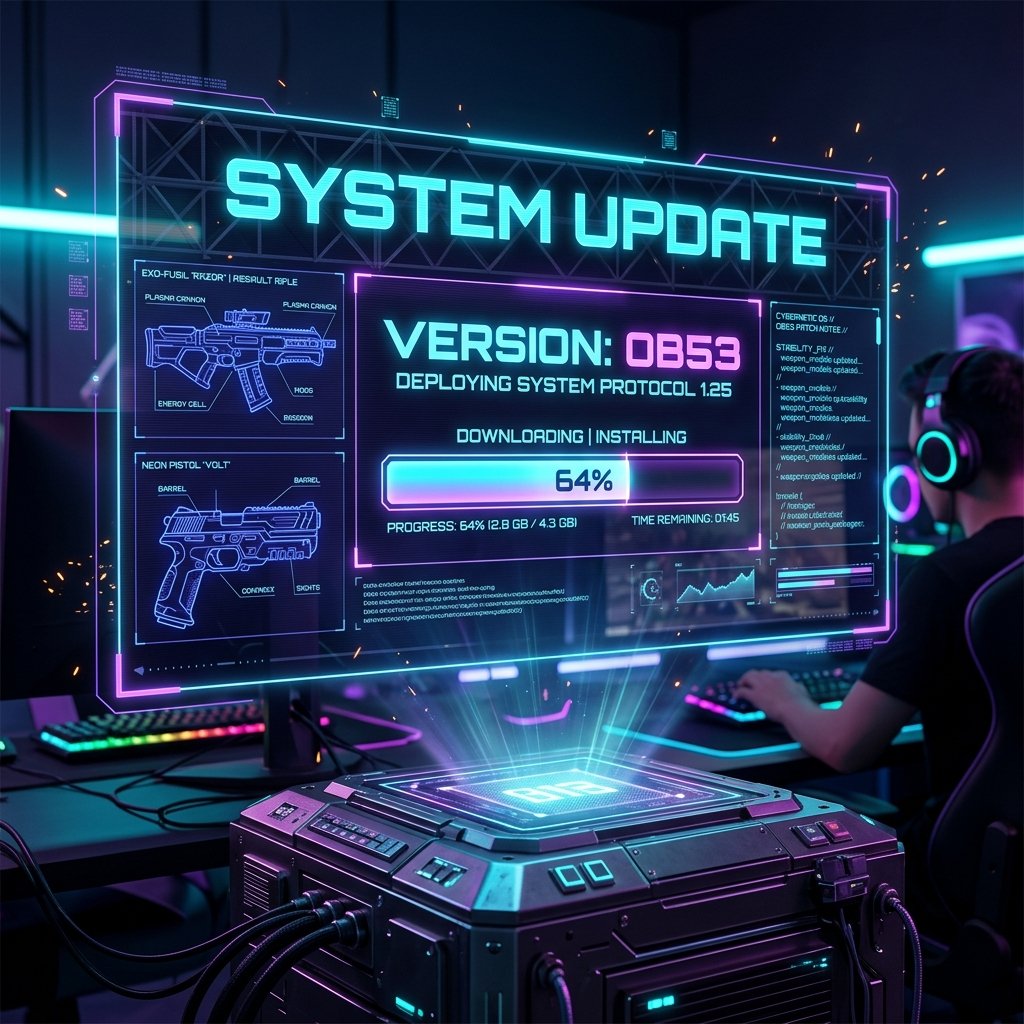
The release of Garena's Free Fire OB53 update has sparked massive interest across the global gaming community. Players routinely search for terms like the "Astute Beta OB53 APK" hoping to bypass official registration wait times. This comprehensive analysis separates rumors from verified technical features and explains how to safely access the official update without compromising your account.
The Garena Free Fire Versioning & Update Lifecycle
To understand how update files leak and why unofficial versions trend, you must understand how Garena manages their development lifecycle. In the Free Fire ecosystem, "OB" stands for Open Beta. However, despite the technical terminology, an OB release is actually a major global patch pushed to live production servers.
The lifecycle of a Free Fire update is a highly structured, five-stage process:
- 1. Internal Code Freeze: The development team freezes feature additions and tests the build internally to detect major rendering bugs and compiler errors.
- 2. Staging Deployment (Advance Server): Garena compiles a dedicated, secure preview build and hosts it on separate testing servers. This is the official "Free Fire Advance Server." A select group of players is invited to test features and report bugs in exchange for in-game currency rewards.
- 3. Data Collection & Balance Adjustments: Garena monitors server latency, tick rates, and player telemetry from the Advance Server. If a new weapon or character skill is determined to be over-powered (OP), they apply patches to balance it.
- 4. Main Store Submission: The optimized build is submitted to Google Play Store and Apple App Store for security compliance and API checks.
- 5. Global Production Launch: Garena takes the game servers down for a maintenance window (usually lasting 8 to 12 hours) and rolls out the update globally.
Because players are anxious to try features during Stage 2 (Staging), they often search for unofficial downloads like the "Astute Beta OB53 APK" to skip registration. This search behavior is exploited by malicious distributors who host fake, infected files.
Inside Garena’s DevOps: The Release Management and Deployment Pipeline
The rollout of a major release like the OB53 patch is not a simple upload process. Garena manages a massive, distributed infrastructure supporting millions of concurrent users globally. This requires a sophisticated Continuous Integration and Continuous Deployment (CI/CD) pipeline coupled with a multi-tiered deployment architecture. Here is a technical deep dive into how Garena compiles, validates, and deploys Free Fire updates:
1. Automated Compilation and Build Pipelines
Free Fire is built on a highly customized version of the Unity game engine. In Garena's development environments, code integration occurs constantly. Developers commit code changes (written in C# and Lua) to central Git repositories.
Each commit triggers automated build pipelines hosted on enterprise build farms (using systems like Jenkins and GitLab CI). Headless Unity instances are instantiated on high-performance servers to compile target binaries for different CPU architectures:
- ARMv7 (armeabi-v7a): A 32-bit compilation target designed to maintain compatibility with legacy mobile processors. Although slower and limited in memory addressing (up to 4GB of RAM), it remains critical for player bases in emerging markets.
- ARMv8 (arm64-v8a): A 64-bit compilation target that optimizes register usage and memory alignment, allowing the game to take full advantage of modern multicore mobile chipsets. It improves rendering efficiency and reduces CPU bottlenecks in intensive combat situations.
2. The Multi-Ring Progression Model
Garena employs a progressive rollout model to prevent regression bugs from affecting the global player base. The deployment progresses through structured staging rings:
| Deployment Ring | Target Audience | Primary Verification Metrics | Rollout Scope |
|---|---|---|---|
| Ring 0 (Alpha) | Internal QA & Bots | Memory leaks, server tick rates (30Hz/60Hz), null pointer exceptions | Internal servers only |
| Ring 1 (Staging) | Advance Server Testers | Player telemetry, character skill balance, crash rates, device thermal throttling | Selected regional users (~100k) |
| Ring 2 (Canary) | Live Production (Selected Region) | Application Not Responding (ANR) rates, matchmaking latency, database migration times | 1% to 10% of regional users |
| Ring 3 (Global) | All Active Players | CDN cache hit ratios, regional network latency, API gateway load | 100% of global users |
3. Canary Rollouts and Real-Time Telemetry
On global release day, Garena utilizes canary deployments. The OB53 update is initially enabled for a small fraction (e.g., 1%) of players in a specific region. Real-time telemetry dashboards monitor performance indicators such as crash rates, server load, and latency spikes. If the metrics remain below strict quality thresholds, the update percentage is incrementally increased. If a critical bug is detected, the deployment is halted, preventing a widespread outage.
4. Over-The-Air (OTA) Hot-Patching and Dynamic Assets
For minor gameplay adjustments, balance changes, or event banners, Garena bypasses the App Store approval process by utilizing an Over-The-Air (OTA) hot-patching pipeline. This system leverages Unity's Addressable Asset System.
When the game client boots, it queries Garena's version management API. If a newer asset manifest is available, the client downloads compressed delta files (often containing Lua scripts and asset bundles) directly from CDN edge servers. This allows Garena to fix critical gameplay bugs within hours without requiring players to download a completely new APK from the app store.
Technical Analysis of Confirmed OB53 Gameplay Mechanics
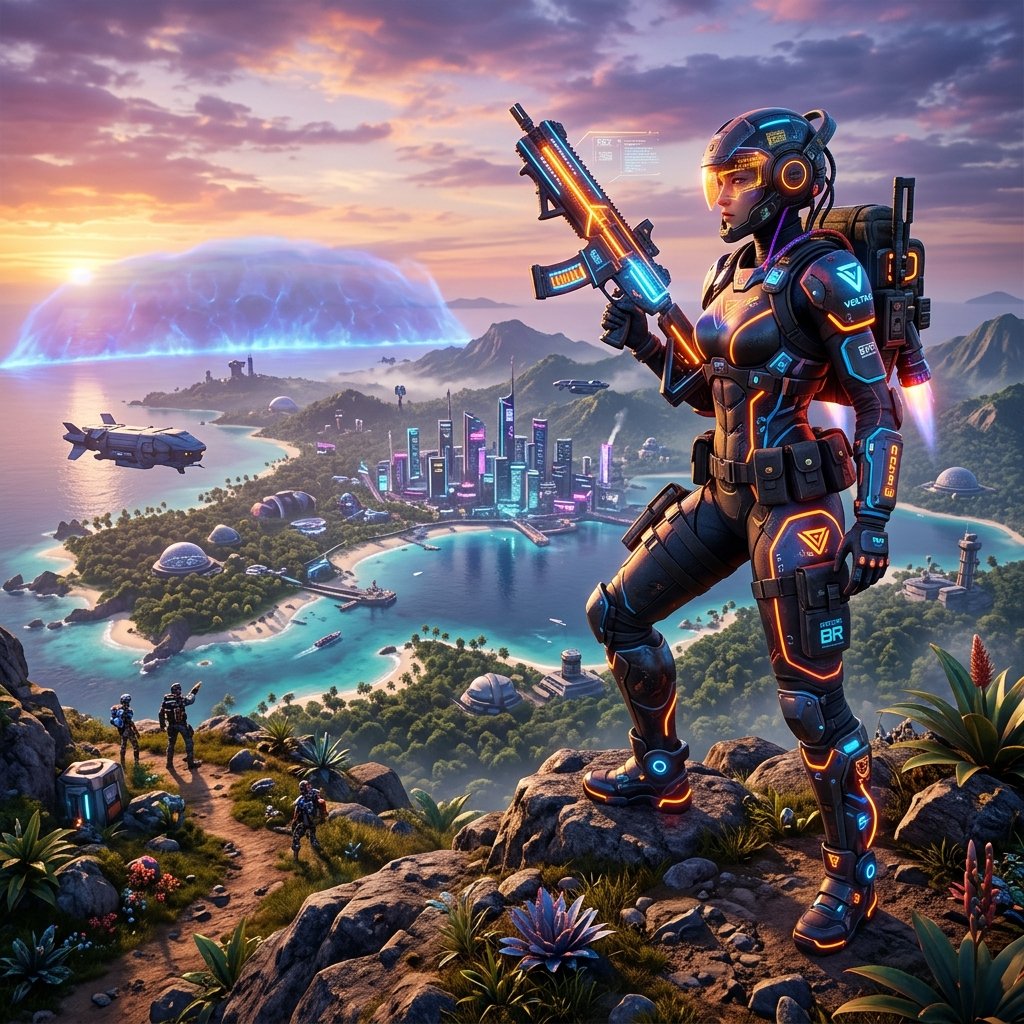
Based on official developer patches and verified logs from the Advance Server staging, the OB53 patch introduces some of the most complex mechanical adjustments in Free Fire history.
1. Aquatic Combat & Deep-Water Physics
Historically, water bodies in Free Fire acted as passive zones. Players swimming were highly vulnerable as they could not draw weapons, run, or utilize protective items. The OB53 update introduces Aquatic Combat, altering water physics:
- Oxygen Depletion Meters: A circular gauge appears when a character dives below the surface. Submerging reduces your visibility to opponents but requires resurfacing before the gauge depletes to avoid rapid HP loss.
- Weapon Restrictions: Only specific lightweight firearms (like pistols or submachine guns) and specialized aquatic harpoons can be fired underwater. Heavy rifles and snipers are locked.
- Drag Coefficients: Projectiles fired underwater experience drag, decreasing their effective range and accuracy. Close-quarters melee weapons (like the Scythe or Katana) feature modified underwater swing speeds.
2. Mounted Horse Travel & Mounted Combat
In addition to traditional motorized vehicles, the OB53 update introduces rideable horses. This mount has distinct combat characteristics:
- Saddle Mobility: The mount can traverse rough, mountainous terrains that would trap a vehicle. It features high jump metrics, allowing players to leap over barricades.
- Mounted Shooting: Players can aim and fire their primary weapons while riding. However, Garena applies a recoil and accuracy penalty to balance this speed advantage.
- HP Partitioning: The mount features its own health pool. If the mount's HP is depleted by enemy fire, the player is thrown from the saddle and temporarily stunned.
3. Tactical Character: Ray
The OB53 update adds "Ray," a tactical support character designed to counter aggressive rush strategies.
- Active Ability - Cybernetic Shield: Ray projects a localized energy field. Allies inside this field gain a 25% damage reduction against incoming explosive and sniper fire.
- Passive Skill - Data Sync: When Ray uses a healing item, the HP recovery rate of teammates within a 15-meter radius is increased by 15% for 5 seconds.
Google's Split APK (AAB) Architecture vs. Monolithic Mod APKs
To optimize storage and network usage, modern mobile developers do not compile games as a single, massive APK. Garena compiles Free Fire using **Android App Bundles (AAB)**.
When Google Play compiles an App Bundle, it splits the application into multiple sub-APKs:
base.apk: Contains the core code, initialization activities, and standard game layouts.- Configuration APKs (Splits): Specialized split files containing resources optimized for your specific hardware. Examples include
config.arm64_v8a.apk(CPU architecture optimization),config.xxhdpi.apk(high-resolution screen textures), and localized language packs (e.g.,config.pt.apkfor Portuguese).
When you tap update on Google Play, the store detects your CPU, display resolution, and language settings, and downloads ONLY the split files your device requires.
In contrast, unofficial downloads like the "Astute Beta OB53 APK" are distributed as a single, large **monolithic APK**. To compile a monolithic APK, modders bundle multiple resource configurations together. This bypasses the official asset delivery pipelines, which often triggers path errors, visual rendering crashes, and memory leaks. Sideloading these large monolithic files is highly prone to instability on newer Android devices.
Optimizing Asset Delivery: Resource Caching and Delta Patching on Mobile Networks
A primary disadvantage of using unofficial, monolithic files like the "Astute Beta OB53 APK" is that they bypass the highly optimized asset delivery and caching frameworks Garena has developed. Mobile networks, especially in developing regions, are subject to high latency, severe packet loss, and frequent connection transitions. Garena utilizes a combination of advanced caching and data compression techniques to ensure updates install reliably over mobile networks:
1. Content Delivery Network (CDN) Architecture & Edge Caching
To serve hundreds of gigabytes of update data simultaneously, Garena routes requests through global CDN partners. CDN edge servers are deployed at the edges of major ISPs in regions like Southeast Asia, Latin America, and India.
Using Anycast DNS routing, the Free Fire client automatically connects to the geographically closest edge server. This minimizes the physical distance the data packets must travel, decreasing packet round-trip time (RTT) and preventing the download bottlenecks that occur on unofficial third-party file-sharing sites.
2. HTTP Range Requests and Resumable Downloads
Mobile connections frequently drop when users move between cell towers or experience temporary signal blockages. If an update download is interrupted, the official client does not restart from the beginning. Instead, it utilizes HTTP Range Requests (Range: bytes=start-end).
The client queries the file size of the partially downloaded asset bundle on the device's local storage (e.g., /Android/data/com.dts.freefireth/files/). It then requests only the missing byte range from the CDN server. This saves mobile data and prevents download failures on unstable connections.
3. Cryptographic Integrity Audits (SHA-256 and MD5)
When data packets are transmitted over noisy mobile networks, bits can become corrupted, leading to broken assets and app crashes. Garena implements a rigorous hashing verification step:
- Manifest Validation: Before downloading, the client fetches a signed manifest file containing a list of all required assets along with their pre-calculated MD5 or SHA-256 hashes.
- Post-Download Checksum: Once a resource chunk or AssetBundle is fully downloaded, the client calculates its hash locally. If the local hash matches the manifest hash, the resource is committed to cache. If they differ, the block is flagged as corrupted, deleted, and automatically re-queued for download.
4. Binary Delta Compression
Rather than downloading an entire 400MB asset bundle when only a few character textures or audio files are updated, Garena uses binary delta patching. The server calculates the exact byte-level differences between the user's current local files and the new OB53 assets.
The client downloads a small delta patch file (often less than 10% of the full bundle size). A local patching algorithm then applies these byte changes to the existing local files to generate the new, updated asset bundle directly on the device. This process dramatically reduces the data overhead required to stay updated.
The "Fake Version Override" Trap: Deceptive APK Scams
Because Garena maintains strict security over the official OB53 staging files, it is nearly impossible for third-party websites to acquire a legitimate, working preview client. To exploit the demand, distributors use a technique known as Fake Version Overrides.
In this scheme, the scammer decompiles an older, readily available Free Fire client (such as OB52). They navigate to the local string resources (e.g., res/values/strings.xml) and search for the version identifier string. They manually edit the string value to say "OB53," repackage the app, and upload it as a "Leaked OB53 Early Access Client."
When you install and open the app, it runs the old code. Once the app tries to connect to the game servers, Garena's server-side checks detect that the actual client hash does not match, displaying a "Server Maintenance" or "Connection Failed" prompt.
While you are trying to troubleshoot the connection, the application executes background Trojan scripts. It scans your local storage directories for cookie files, harvests active login sessions, and attempts to send device metrics to the hacker's server.
OB53 Global Regional Rollout & Maintenance Schedule
To ensure smooth server transitions, Garena schedules maintenance windows by region. During these windows, live game servers are taken offline, and matchmaking is suspended. The table below displays the typical maintenance schedules and release windows across major global servers:
| Regional Server | Maintenance Start (Local Time) | Expected Live Status (Local Time) | Official Update Size (Google Play) |
|---|---|---|---|
| LATAM / Brazil | 00:00 (BRT) | 09:00 (BRT) | ~320 MB (AAB Split) |
| India (FF MAX) | 09:30 (IST) | 18:00 (IST) | ~380 MB (AAB Split) |
| Indonesia / Asia | 08:00 (WIB) | 17:00 (WIB) | ~310 MB (AAB Split) |
| MENA / Middle East | 04:00 (GST) | 13:00 (GST) | ~340 MB (AAB Split) |
| Europe | 03:00 (CET) | 12:00 (CET) | ~330 MB (AAB Split) |
Note: Actual maintenance windows may be extended by Garena if server synchronization issues or backend bugs occur during database migrations.
Behind the Scenes: The Technical Process of Patch-Notes Compilation
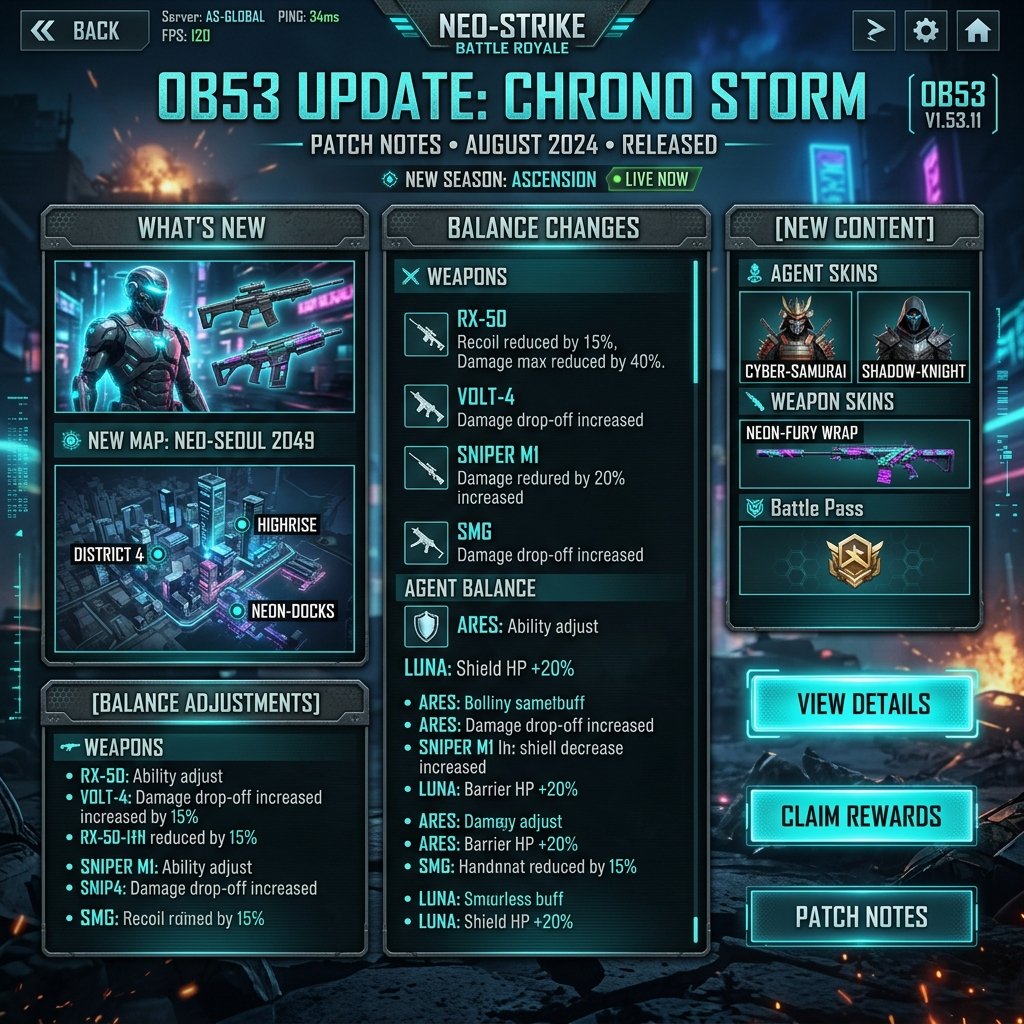
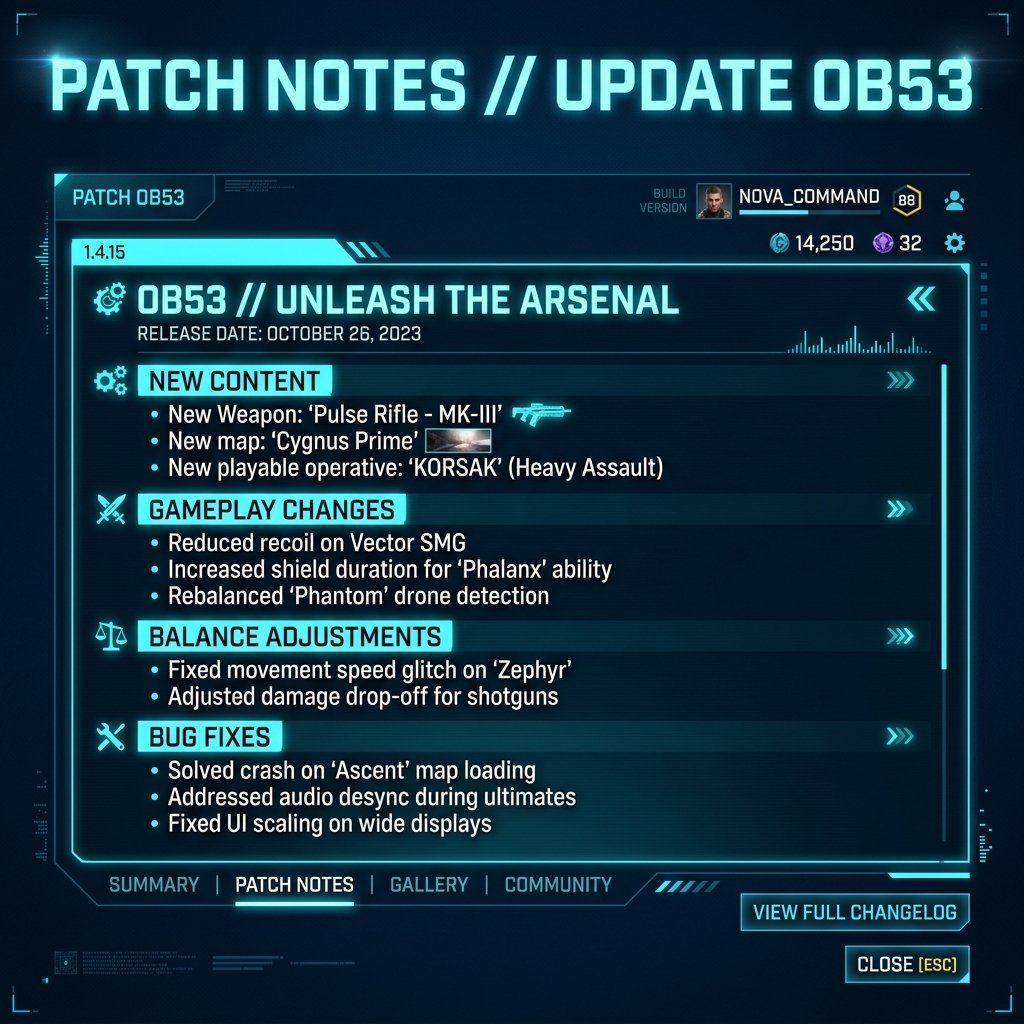
The patch notes published by Garena during major updates like OB53 are not merely marketing summaries; they represent the culmination of an intensive software audit and documentation lifecycle. Translating thousands of code updates, feature merges, and bug fixes into clear, public-facing developer logs involves a highly structured process:
1. Git History Parsing and Automated Change Auditing
Throughout the OB53 development cycle, engineers commit changes to version control systems using structured commit syntax. At the end of the sprint, release managers run automated parsing scripts to compare the current release branch (e.g., release/ob53) against the previous live release tag (e.g., v1.104.2).
The scripts parse commit messages and filter out low-level code refactoring, infrastructure adjustments, and security patches. It compiles a raw changelog grouped by functional areas: UI, Gameplay Engine, Network Protocol, Audio, and Graphics. This raw technical log serves as the foundation for the patch notes.
2. Telemetry-Driven Game Balance Auditing
Many changes featured in patch notes (such as adjustments to weapon damage or character ability cooldowns) are driven by player telemetry analyzed during the Advance Server testing phase. Garena's data analysis platforms ingest billions of events daily:
- Win/Loss Ratios: Telemetry monitors the performance of new gameplay mechanics. For example, if players using the new rideable horses achieve a win rate exceeding a specific threshold (e.g., 55%), the mechanic is flagged as unbalanced.
- Heatmaps and Kill Logs: Engineers analyze coordinates of player combat to determine if the new aquatic mechanics create unfair choke points on the map.
- Dynamic Tuning: Balance designers adjust coefficients in the game's physics and weapon configuration databases based on this data. These adjustments are then committed, verified, and added to the official patch notes (e.g., "Reduced underwater projectile velocity by 15%").
3. Global Localization & String Database Synchronization
Because Free Fire has a global player base, patch notes must be translated into dozens of languages, including Portuguese, Spanish, Hindi, Indonesian, Arabic, and Thai. Garena utilizes a localized translation management system connected directly to their content repositories.
Once the core patch-notes draft is finalized in English, it is automatically pushed to regional localization teams and translation agencies. These translations are reviewed to ensure regional gaming terminology is used correctly. The finalized strings are then synchronized across Garena's in-game notice boards and official web portals, ensuring that players in all regions receive identical, accurate information when the maintenance window concludes.
4. Platform Policy Compliance Reviews
Before patch notes are published, they undergo legal and platform policy compliance reviews. Major app stores like Google Play and Apple App Store enforce strict guidelines regarding disclosures of loot box odds, monetization changes, and data privacy policies. Garena's compliance team audits the release notes to confirm all descriptions align with these platform rules, protecting the application from sudden store flags or suspension.
Verification Steps: Confirming File Authenticity
Before installing any package claiming to contain the OB53 patch, verify its authenticity using this security checklist:
- Verify the Download Domain: The only verified domain hosting Garena Advance Server files is
ff-advance.ff.garena.com. If the URL contains sub-domains, numbers, or redirects to file lockers (such as MediaFire or Mega), it is not an official file. - Audit the Cryptographic Certificate: Run the APK through a tool like
apksignerto verify its signature. Legitimate packages display Garena's official developer certificate. An anonymous or self-signed signature indicates the app has been modified. - Run Antivirus Heuristics: Upload the APK file to VirusTotal. Detections like
Riskware/Android.Agentor generic trojan flags mean you should delete the file.
Step-by-Step Guide: Accessing the OB53 Update Safely
To test the OB53 patch features safely, follow the official registration process:
1. Access the Registration Portal
Open a web browser and navigate to the official portal at ff-advance.ff.garena.com. Avoid utilizing searching shortcuts on unverified search pages that redirect to clone websites.
2. Authenticate Your Profile
Log in using a Facebook or Google profile that is directly linked to an active Free Fire gaming account. Profiles that have not played the game on live servers are typically filtered out by the registration system.
3. Fill Out Contact Details
Provide an active email address and phone number. Garena uses these contact details to distribute acceptance notifications and login credentials.
4. Retrieve the Code & Official APK
Once approved, copy your unique Activation Code from the dashboard. Download the official, signed APK directly from Garena's servers. Paste the Activation Code when opening the client to start testing.